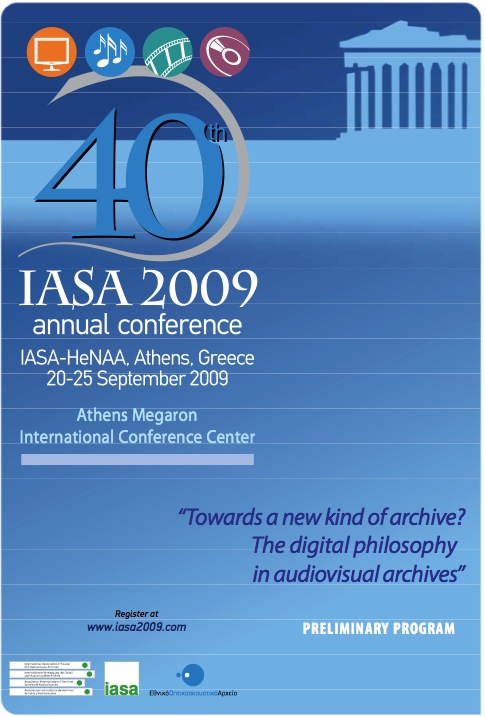
Annual Conference: Athens, Greece (IASA solo conference)
President: Kevin Bradley, National Library of Australia, Australia
Editor: Dr. Janet Topp Fargion,The British Library Sound Archive,London, UK
I am both pleased and honoured to be taking on the Presidency of IASA at this time; there are so many important projects and plans being carried through by our members that are poised ready to go, that I believe through its ongoing work, IASA will be making an even bigger contribution to the sound and audio visual archiving community. The generosity of the IASA membership is notable. An outside observer to our Sydney 2008 conference commented that our IASA conference was unlike any other they had seen because we were prepared to share unreservedly so that others can benefit from the cooperation.
There is a conundrum known as "the prisoners' dilemma" which describes a scenario in which two people have much to lose and much to gain. The choices they make affect their own fortunes, but in the long run the best result for the individual is gained by cooperating and achieving the best benefits for all. The 2008 conference theme of "No Archive is an Island" pointed at our critical interdependence, "no archive is an island complete of itself", as we were reminded at this conference, any loss reflects on us all, and likewise, any interconnection is the responsibility of us all. In this time of interconnection there are so many possibilities for us to find ways to work together, the possibilities for IASA have increased, and so have our responsibilities. I think lASA's members understand very clearly the benefits of working for the general good.
This was clearly the case in September, for the sun had barely set on the Sydney conference when the newly elected IASA Executive Board, fired with enthusiasm, began talking to the even more energetic planners for our next conference which is to be held in Athens. "Towards a New Kind of Archive? The digital philosophy in audiovisual archives" is the theme and there promises to be many exciting issues to be examined. By the time you read this you will no doubt have seen the call for papers and be thinking about the presentation you will be making. The large number of excellent and varied paper proposals we have been receiving for the IASA conferences in the past few years make for very rich conferences, and I encourage you all to apply the same sharing attitude and creative thinking to our 2009 conference.
As well as the conference we have IASA publications. Near to my heart, and now near to completion, is the second edition of IASA TC-04, "Guidelines in the Production and Preservation of Digital Audio Objects", which is now ready to be published. The new edition TC-04 not only informs readers about developments in digitisation processes since it was first published five years ago, but is expanded with current information on important topics such as metadata, guidance on naming and numbering of files and digital works, preservation target formats and systems structured around the OAIS model, and a discussion of partnerships, project planning and outsourcing. There is also a chapter on preservation and field recording technology and approaches. There are more than 140 pages, up from the 80 pages of the first edition, of authoritative information on the world of audio preservation. Its new form and new information is entirely due to the hard work of the IASA technical committee who have tirelessly updated and proof read the content. IASA has received a number of generous offers of sponsorship and support, and we hope to launch the new edition in March.
Thanks to the efforts of the Research Archives section a draft of Professional Ethical Principles for IASA is currently circulating amongst sections and committees and general members. Though we have "IASA TC-03 The Safeguarding of the Audio Heritage: Ethics, Principles and Preservation Strategy" to guide us in matters regarding the ethics of managing the technology of sound preservation, there has been a need for us to codify the underlying ethical principles that inform our practice as sound and audio visual archivists. The current discussion moves us ever closer to making this document widely available for IASA members, and to inform others about our standards.
Training is one of lASA's major responsibilities, and the training committee's agenda and planned meetings point to some new developments in this area too. IASA has had a research grant in place for some time, but it has become inactive over time and the IASA board will be looking at how to make this active in the near future. And these are only some of the things that are in train; the agenda for us is, if not full, certainly extensive. We look forward to reviewing these and all our other plans in the mid year board meeting in March.
The reason it is such a pleasure to take on the IASA presidency at this time is that the transfer from the old board to the new has been so smoothly managed that there is little or no loss in momentum on these and other important projects. My grateful thanks go to the outgoing IASA executive board for the past three years' work, and the support of the new board. Special acknowledgement should go to Past President Richard Green, whose time at the helm has been marked by many successes and whose involvement in the new board will be much valued, and to Gunnel Jönsson, who as Secretary-General has been the navigator for IASA over the past two terms. Thanks also to Per Holst, whose tireless work in recent years as the IASA board's representative for conferences has helped to shape some memorable events, and to Kurt Deggeller, whose time as President and ast President has come to an end, but whose important connection with IASA will continue.
The new IASA executive includes Ilse Assmann as Secretary General, returning again after a successful time as editor, Pio Pellizzari as Vice President and convener of the training committee. Jacqueline Von Arb as Vice President for membership, and Richard Green returning in the role of Past President. New to the IASA executive is Janet Topp Fargion, from the British Library who has shouldered the task of editor, Lidia Camacho, from the Fonoteca Nacional in Mexico, Vice President with responsibility for membership in the Americas and for conferences, and myself, from the National Library of Australia. We all anticipate working hard for a forward looking IASA.
Kevin Bradley Canberra,
Australia December 2008