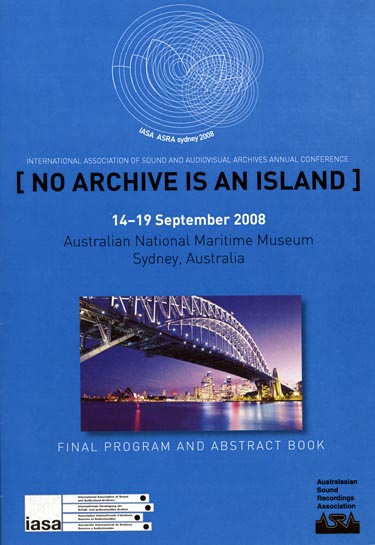
Annual Conference: Sydney, Australia (with ASRA)
President: Richard Green, National Library of Canada, Canada. Kevin Bradley, National Library of Australia, Australia
Editor: Ilse Assmann, The South African Broadcast Corporation Sound Archive, Auckland Park, South Africa. Dr. Janet Topp Fargion, The British Library Sound Archive, London, UK
Early in June I gave a paper at the annual conference of the Canadian Association of Music Libraries, Archives and Documentation Centres. Initially my focus was on the evolution οf the digital universe in the sound and AV world over my time with IASA. As I started to write, I found I was deviating into another theme, changes in IASA itself, many which have happened as a by-product of digitization.
I compared four IASA conferences, with the 1992 Australia conference as a starting point. Why Australia? Partly because it tied in with this year's conference, making a nice circle, but also because Australia '92 was one of the first conferences to look at what digitization and digital networks might mean for sound archives, particularly in a paper by Albrecht Häfner that, looking back, seems very farsighted. As I looked at the programmes for the other conferences I had selected, Aarhus (2002), Barcelona (2005), and this year, and the notes from the various Board meetings, it seemed to me that each conference programme was trying to address current questions in the archival world and each Board meeting was trying to deal with the challenges that were confronting IASA as an organization. For each year, I tried to determine the key questions on the AV and IASA agendas. The last of my questions for the 1992 Canberra conference was, "Where's the bar?"
Now I meant that to be humourous, because if anyone can locate the nearest bar in an unfamiliar location, it is a IASA member, especially the cigar smoking IASA types. I was also suggesting that in 1992 it was pretty much a business as usual for sound archives and for IASA. lASA's membership was stable and the expectations of our members were pretty consistent. Times were good. But, in a dry run of the presentation, one of my more astute colleagues pointed out that, "Where's the bar?" has a double meaning in English. It can also mean: What is our level? Where do we set the bar? How high can we jump? - a bar in this case being a long piece of wood or metal that is placed at a certain level such as for a high jump.
Looking back over on my involvement with IASA, including the six years that I have been on the Board, it is very clear the "bar" has been continually raised.. The three years of this Board's life has seen many bar-shifts. These include an increasing interest in our annual conferences by those inside and outside IASA. Our conferences are recognized as an important venue for discussing the broad impact of contemporary technological and organizational changes IASA conferences have moved beyond sound to address the convergence of technology as represented by the now consistent inclusion of AV- wide topics in the conference programme This Board has worked internationally with our colleagues on the CCAAA, with UNESCO and on projects like the European Digital Library and the JTS. We have participated in or supported IASA members in training and education sessions in Latin America, Asia, Europe and Africa. We have re-established the Training and Education Committee. The Journal, Bulletin, e-bulletin, and web site have been consistently interesting and regularly reporting on the growth of the digital world. The Board has not shied away from often difficult issues such as providing funding and assistance to Board members and members from the developing world, raising the membership fees, adapting to the growing interest in IASA on the part of commercial operations including the emerging impact of public-private partnerships, and adapting conferences and publications to the changing nature of the AV world.
Raising the bar over the last three years would have been impossible without the dedication of the Executive Board. I have been extremely fortunate to have had the assistance and cooperation of Ilse Assmann, Kurt Deggeller, Per Holst, Gunnel Jönsson, Anke Leenings, Pio Pellizzari, and Jacqueline Von Arb. I should also like to acknowledge Anke 's assistant, Cornelia Hellborn, an invaluable IASA supporter. My heartfelt thanks to you all!
For the incoming Board, we have left completion of a IASA ethics document started by the Research Archives Section, putting our sponsorship opportunities together on a well-planned professional basis, the distribution of a new bigger and better edition of TC-04, the preparation of TC-05, planning for the next JTS in 2010 in Oslo, ongoing commitments to the CCAAA including the introduction of a Joint Management Symposium being spearheaded by SEAPAVAA, the European Digital Library, and the continued broadening of lASA's membership base and participation internationally.
Of all the upcoming challenges facing IASA, and other international organizations that rely on institutional support, I personally suspect that the biggest will be adapting to the shifting priorities of our member organizations. They have, without notice, and perhaps unintentionally, adjusted the bar. Partly as a by-product of the digital revolution, institutions are evolving, mutating into something that tries to meet perceived, anticipated, and real governmental and societal shifts and expectations. Senior managers of our institutions are no longer career archivists or librarians, and are usually not knowledgeable on sound and AV issues. They no longer personally participate in IASA nor do they see the need for their staff or their institutions to involve themselves on an ongoing basis. IASA needs to reach out to this community. This is a considerable challenge but is also an opportunity to restate, clarify, and communicate lASA's aims, its shared vision, and its dedication to working internationally to assure the long-term preservation of our shared AV heritage.
As usual the new Board will deal with unexpected topics that seem to arise when one least expects them. Each new Board faces a new reality. I expect though, that at the end of the day, incoming President Kevin Bradley and his Executive Board will be asking that ongoing IASA question - "Where's the bar?"
Richard Green Ottawa, Canada July 1,2008